
Ask themin parallel.Fuseto the top.
Beam fans one prompt across N frontier models, then synthesizes the strongest answer from all responses.
Big-AGI Beam
Runs multiple models together on one prompt. Highly acclaimed UX.
This is Beam.
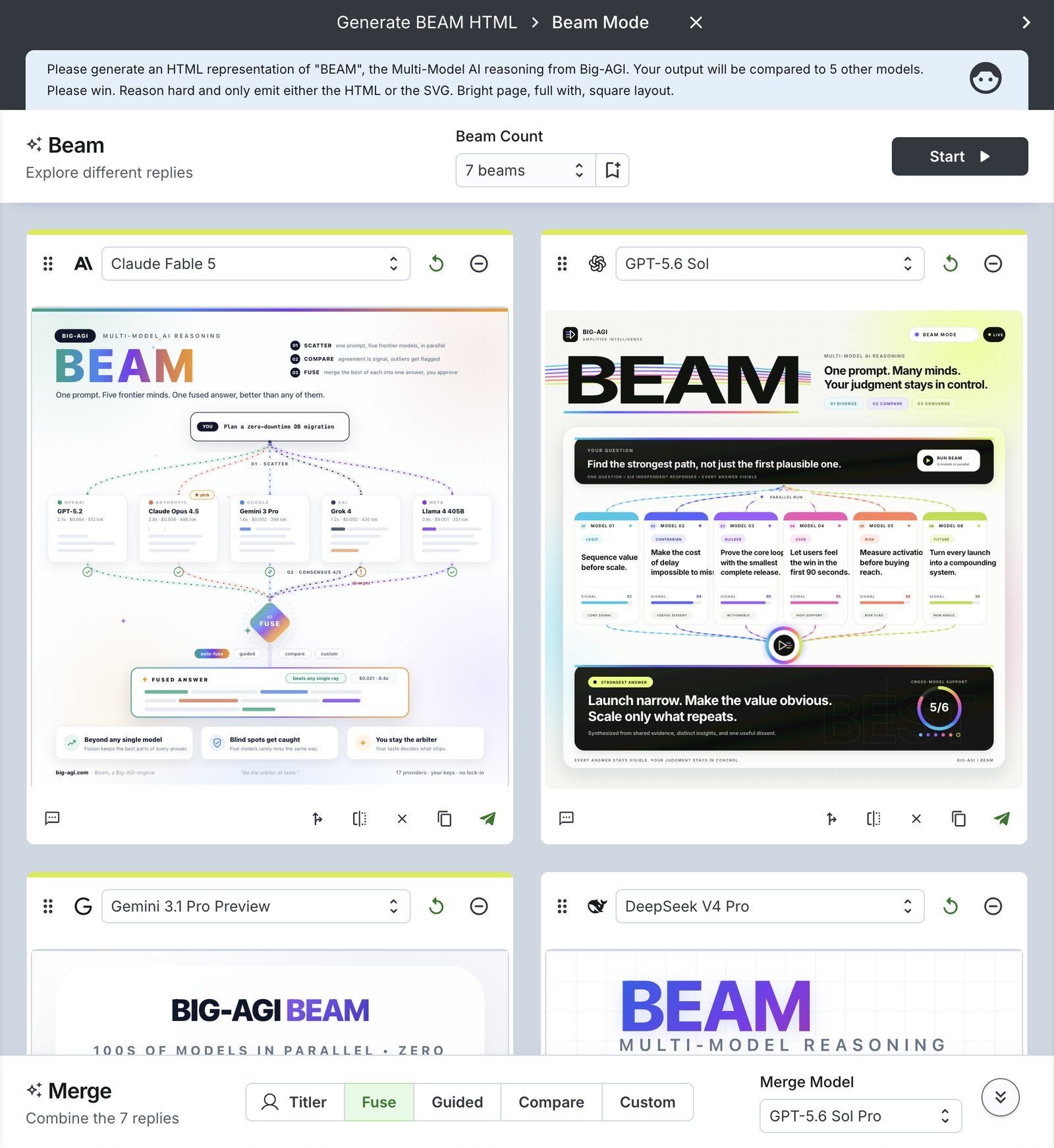
A visual SVG run: seven beams handed one prompt - design Beam's own page. Claude, GPT, Gemini, DeepSeek, Kimi, GLM and Grok answer side by side, blind to each other. Fuse then merges the strongest of each.
One model is a guess.
N models is smarter.
Maybe right?
Maybe hallucinating?
Is this the right answer?
You ship the answer, hope for the best. No second opinion. No way to spot drift, bias, or fabrication until production.
Reveal gaps.
Catch fabrications.
Fuse the top answer.
Same prompt, multiple frontier models, in parallel. Answers land side by side, so consensus and outliers are obvious. You decide.
Explore Multiple Dimensions
Same question.
Different everything else.
A beam is not just a second model. Change the mind, the expert, or the settings on each one. Then select any reply, branch a fresh chat from it, or merge them all.
change models
Same question,
different neurons.
Send it to GPT, Claude, and Gemini at once. Or run the same model five times for five independent draws. Each beam is its own thread of thought.
change personas
Same question,
different expert.
Put a persona in each chair: a senior engineer, a skeptical scientist, a sharp editor. Same question, a different expert answering. Personas and their memories persist, and sync across your devices.
change parametersUpcoming
Same question,
different settings.
Tune each beam on its own: thinking budget, reasoning effort, web search on or off, context window. One click for Max mode (every model at its ceiling) or Search mode (live web on every beam).
No single model is perfect
Every model has tradeoffs.
Pick one model and you get its superpowers, but also inherit its blind spots. Beam fields the whole roster, so the best model for coding, the best for images, and the best for research all answer the same prompt.
01
Ask
N models, one prompt, simultaneously.
Pick from any frontier model: Claude, GPT, Gemini, DeepSeek, your local Kimi, GLM or Gemma. Hit Ctrl + Enter and the prompt fans out to all of them at once.
02
Check
Agreement = confidence, divergence = signal.
They answer blind: different companies, different training data, no model sees the others. When they converge on the same answer, that consensus is hard to fake. When they diverge, the disagreement is a flag: a place to dig deeper and iterate.
03
Merge
Fuse the strongest answer.
Merge then runs a meta-pass: every response is fed to a model of your choice, which fuses them into one final answer that combines the best of each.
The MERGE Programs
3 predefined synthesis algorithms, plus a custom option.
Fuse
Auto-selects the strongest parts of every answer and writes the one you keep.
Guide
A checklist of the distinct ideas found across the answers. Tick what matters, Beam merges along your picks.
Score
A structured table of where the answers agree, differ, and win. Built for decisions.
Custom
Your own merge prompt, with editable separators. The meta-pass is fully yours.
Upcoming
Council
Coming to Beam, inspired by Andrej Karpathy’s LLM Council: every model reads and ranks the others’ answers, the scores are tallied, and the highest-rated response wins. An LLM council that grades itself, with no single judge deciding. Also known as an LM Council, a council of models, or LLM-as-a-judge applied across vendors.
In development · best-of-N by consensus-of-N · tell us if you want it
Iterate to the solution
The right answer is
a few passes in.
Iterate to perfection. Edit earlier messages, fold the strongest lines from each reply back into your query, and re-run the ensemble. Every pass lands tighter, and your history keeps every version to branch from.
1
edit any message
Rewind to any earlier turn, edit it, and re-run from there.
2
harvest across beams
Feed the strongest lines from each reply back into a sharper prompt.
3
beam again
Each pass lands tighter than the last -> the answer LOCKS IN.
Voices · verbatim
What people do
with Beam.
I.
Especially with beam, when there's consensus across gpt, Claude, Gemini it means gold. When there's discrepancies, that's where it indicates deeper dive with more details needed
Parent & Maker · Award-winning result, 50 teams
II.
Your work is literally saving lives per my use
ER Physician · 1yr+ daily
III.
I've been looking for something to speed up my productivity when testing multiple models, and Big-AGI has been the best option I could find so far!
AI Researcher · GitHub Sponsor
Straight answers
Why different model families instead of one model sampled N times?
Sampling one model five times gives you five draws from the same distribution, with the same blind spots. Beaming across families (GPT, Claude, Gemini, and friends) diversifies the failure modes, so a hallucination rarely survives the vote. The research points the same way: ensembles of agents outperform single models, and Beam pushes the idea further by ensembling across vendors instead of copies. The wisdom of crowds, applied to frontier models.
Grounded in the ensemble literature
How is Beam different from Perplexity’s Model Council or OpenRouter’s Fusion?
Mostly, it is the same shape, and that is the point: Model Council, Fusion, and a hundred LLM-council projects all fan one prompt across a panel of models, then let a judge write the final answer. Beam differs in two places. First, the merge: elsewhere a hidden last step, in Beam half the product. You pick the program (Fuse, Guided, Compare, or your own instructions), you read every raw answer, and you can overrule the result, because automated synthesis tends to average away the minority insight that made N models worth running. Second, the exploration: a beam varies more than the model. Personas, web search, reasoning budgets, parameters, saved together as Beam Teams for each job.
2024 · Apr
Beam ships in Big-AGI: parallel beams, fusion right from the start.
2025 · Oct
Beam 2 ships: multi-modal image support, follow-ups on any beam/merge, Search and Max modes, improved merges, Beam Teams.
2025 · Nov
Karpathy’s llm-council names the pattern.
2026 · Feb
Perplexity Model Council ships, on the $200/mo tier.
2026 · Jun
OpenRouter Fusion ships, a panel of eight behind an API.
2026 · Jun
Sakana Fugu ships: a multi-agent system delivered as one model. The GPT-5 Pro pattern but across model families.
Names named in good faith · July 2026
Is running N models N times the cost?
Roughly, yes, and on the prompts that matter it earns its keep: a few extra cents to catch a wrong answer before it ships is cheap insurance. You also stay in control. Run two beams instead of six, use fast or local models for the wide pass and a frontier model only for the merge, or reserve Beam for the high-stakes questions and single-model chat for everything else. Beam runs on your own API keys, so you pay providers directly at cost, with no markup from us.
On cost and control
Why the name Beam?
Beam, as in beam search. It’s a classic search algorithm: when the solution space is too big to fully explore, you advance a few promising candidates in parallel, keep the best, and step from there. That’s exactly what this is: every run of Beam expands one level: N models, or variations, probing the solution space in different directions that are innate to them. Merge is the repositioning step, picking one candidate, or consolidating where the probes found the most promise. Beam again from there, and within a few levels you converge on an answer no single exploration would have found. The animations on this page try to represent this.
Trivia · from the founder
When the answer matters,
Beam it.
Beam ships inside Big-AGI. Ensemble reasoning for engineers, researchers, and operators who can't afford to ship a hallucination.
Native support for every major model, the day of release
Your keys, your data, your conversations
Personas with data that remember across sessions
The original parallel multi-model interface: Beam
BIG-AGI
Resources
© 2026 Token Fabrics·Built with passion in San Diego